In climate and conservation spaces, seafood has often been embraced as a green protein that’s lighter than beef, aligned with ocean protection, and backed by a growing web of sustainability standards. Over time, it became a default answer to a difficult question: how to address food-related climate impacts without asking people to move away from animal protein altogether.
But that framing is the result of decades of misleading industry messaging and pressure on lawmakers that ultimately positioned seafood as the responsible choice, despite its hidden harms.
The Blue Revolution and the Search for a “Better” Protein
As concern about overfishing grew in the late 20th century, the aquaculture industry presented farmed fish as a necessary transition from wild-caught fish—a solution to protect wild stocks, reduce carbon emissions, and meet rising demand.
This narrative offered a way to keep animal protein central while moving away from the most emissions-intensive meats. As climate commitments began targeting beef, foodservice operators still needed a protein that felt familiar and scalable. Seafood appeared to offer a straightforward substitution within existing menus.
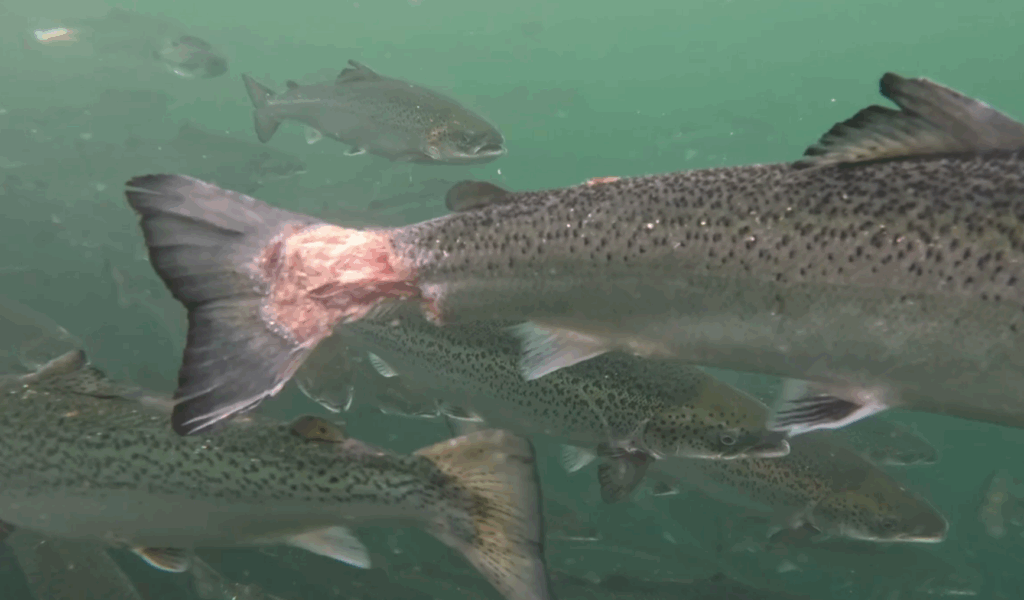
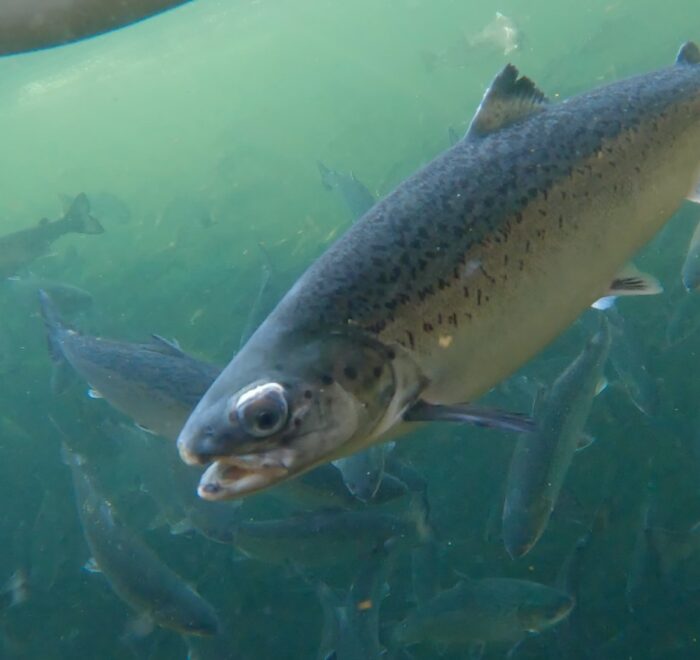
Right: A salmon with an injured tail swims at a Mowi certified “sustainable” farm in Scotland. (Source: Abolish Salmon Farming)
But aquaculture largely escaped scrutiny over whether it actually delivered the benefits it promised, or whether the search for a “better” animal protein narrowed the solution space from the start.
Across nine major farmed aquatic species, research from the Johns Hopkins Center for a Livable Future shows that only about 19 percent of protein and 10 percent of feed calories are ultimately retained for human diets. These losses are comparable to—and in some cases worse than—those seen in other forms of industrial animal agriculture. Fish farming does not correct the inefficiencies of meat production; it largely reproduces them underwater, expanding the supply of animal protein while carrying many of the same ecological and resource costs as factory farming on land.
The climate picture reinforces this point. Life-cycle analyses show that farmed fish, on average, emits more greenhouse gases than poultry and pork, and roughly thirteen times more than protein from peas. Freshwater demand follows the same pattern: animal proteins, whether from land or sea, consistently require far more water than plant-based sources such as legumes. Together, the evidence suggests that swapping one animal protein for another doesn’t ease the ecological burden—while shifting toward plant-based proteins delivers far larger gains across climate, water, and resource use.
At the root of these inefficiencies and impacts is a production model borrowed directly from terrestrial factory farming. Open-water pens crowd hundreds of thousands of fish into confined spaces, concentrating waste, parasites, and disease. Chemical treatments and antibiotics are used to manage conditions created by these systems, while feces, uneaten feed, and pathogens flow directly into surrounding waters.
How Industry Shaped the Story
This bleak reality, however, remained largely hidden. Aquaculture producers and their trade groups invested heavily in shaping how fish farming was embraced by the public and regulated by policymakers, paving the way for rapid growth without constraints.
“Project Japan” offers a clear example of the manipulative marketing used by the industry. As sushi began spreading globally, salmon producers moved to insert farmed Atlantic salmon into a cuisine where it had never traditionally belonged. In Japan, salmon was long avoided in sushi because it was considered unsafe to eat raw due to parasite risk. Norwegian salmon companies rebranded the fish as clean, safe, and modern, normalizing it among Japanese chefs. What appeared to be an organic culinary shift was, in reality, a coordinated effort to create demand, embedding farmed salmon into global sushi culture.
In Chile, expansion was achieved through policy. Salmon farming companies secured long-term concessions over public waters. These arrangements function much like private property rights, locking in industrial use and limiting oversight. In 2016, when Chile faced a massive red tide crisis, the industry pressured the government to allow it to dump tons of dead fish, worsening the algal bloom and leaving local communities to clean up.
Together, these examples show how the aquaculture industry engineered the conditions for its exponential rise. Seafood did not become the default “ocean-friendly” protein because demand required it, but because the industry worked to make it appear inevitable.
Revisiting the Default
Defaults shape outcomes, but they are not fixed. The idea that seafood should anchor climate-aligned food strategies is already beginning to loosen as institutions reassess what actually delivers results.
Rather than trying to identify a “better” animal protein, major providers are rebalancing menus so plant-based meals are the standard and animal products are offered more selectively. Companies like Aramark, Compass Group, and Sodexo have committed to making plant-based foods a significant share of their offerings at universities and hospitals, tying those shifts directly to emissions reduction goals. Many dining operations are offering plant-forward menus by default and using light behavioral nudges that reduce animal protein consumption—without restricting choice.

New Directions
The Aquaculture Accountability Project examines how the seafood industry shaped sustainability narratives around fish farming, and how those narratives came to dominate food and climate conversations even as the industry expanded. By separating industry narratives from outcomes that actually protect oceans, AAP supports universities, businesses, sustainability professionals, environmental organizations, and consumers as they move toward foods that reduce pressure on marine ecosystems by relying less on industrial animal production.
Already, seafood’s grip on sustainability planning is loosening, and a new default is taking its place. If you’re ready to become part of the solution, get in touch.