Walk down the fish aisle, and a sea of labels surrounds you: “Responsibly Farmed,” “Sustainably Sourced,” “No Antibiotics,” and various certification logos. Most shoppers assume they can trust these claims and that someone has verified them. Our new report with Farm Forward, Responsibly Farmed, According to Whom? How Major Grocers and an Industry-Run Certifier Vouch for Their Own “Sustainable” Seafood, finds that, for the most part, no independent entity has.
We audited 250 farmed fish and shrimp products with marketing claims at ten U.S. store chains, plus 63 listings on Amazon. Three grocers, Whole Foods Market, Kroger and Albertsons, sold 116 of the 119 in-store products that called themselves “sustainable” or “responsible” without any outside certification, most under labels they wrote themselves. When an outside seal did appear, it usually came from a program the industry runs.
Our Findings
Grocers are vouching for their own fish. Whole Foods’ “Responsibly Farmed” label appeared on 86.7 percent of its farmed fish and shrimp with claims. It’s checked by an auditor Whole Foods chooses and doesn’t name publicly and is paid for by its suppliers, with no results made available to consumers. Kroger says its “Sustainably Sourced” label means that there’s a certification, yet none of the 9 packages with that label showed one. Just 1 of 27 Albertsons “Responsible Choice” products did.
The leading certifier is run by the industry it certifies. Four of every five certified products we found in stores carried Best Aquaculture Practices (BAP). BAP’s parent group was founded by seafood and agribusiness companies, including Cargill and Monsanto. Industry companies account for half of its board, 98.5 percent of its revenue comes from its own programs, and it doesn’t publish audit results. Its record is hard to square with its seal: BAP-certified facilities accounted for 73.1 percent of shrimp rejected at the U.S. border for prohibited antibiotic contamination in the first nine months of 2026.
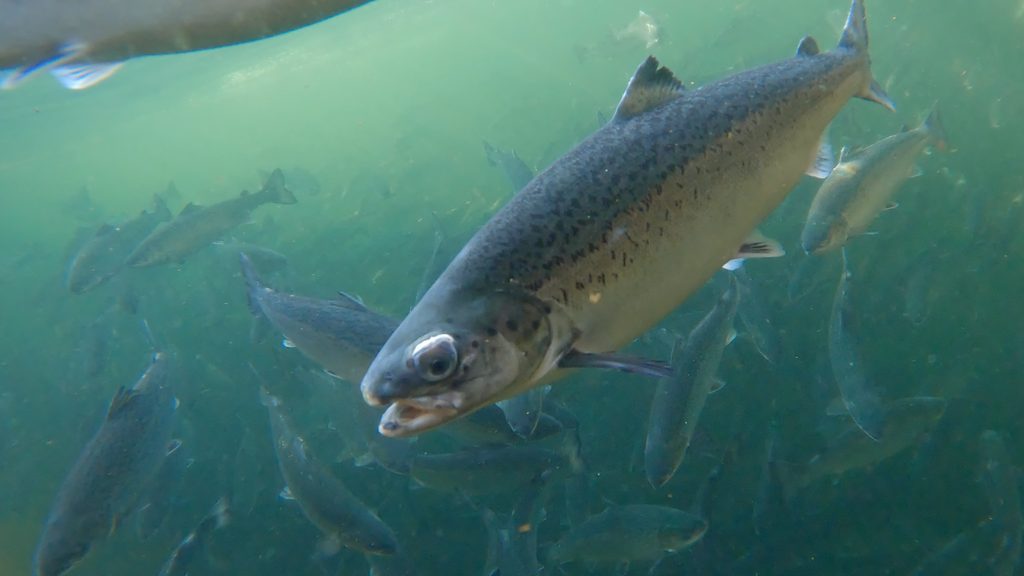
“No antibiotics” runs on the honor system. Fish farms crowd large numbers of animals together, so disease spreads easily and antibiotic use is common. Of the 58 “no antibiotics” claims we recorded, not one was verified by anyone outside the company making it, and 22 appeared on certified products whose certification doesn’t cover the claim.
Labels never mention the biggest harms. Not one of the 250 packages told shoppers how many fish died on the farm, what the farm released into surrounding waters, how many fish escaped, or how much wild fish was caught to feed them. Certification doesn’t close that gap: both leading certifiers let salmon farms use more wild fish than the salmon they produce, up to 2.52 kilograms of wild fish per kilogram of salmon under the Aquaculture Stewardship Council (ASC) and 3 under BAP.
Online, the claims multiply. Amazon listings used sustainability wording nearly five times as often as store packages, and on 15 of 63 listings the claims appeared only in marketing copy or images.
No one is checking. In a 2022 poll, 78 percent of Americans say grocers and restaurants are responsible for verifying the source of the food they sell. Yet no federal agency defines “sustainable” or “responsible” on a fish or shrimp package, and the grocery industry’s trade group has urged the Federal Trade Commission not to create a definition. Shoppers are turning to the courts instead. In July and August 2026, consumers sued Amazon over its seafood sustainability claims, and others sued the U.S. arm of a Chilean salmon farmer over its Mama Bear salmon, marketed as “sustainably farm-raised” and “responsibly sourced.”
The companies making these promises also write the definitions, pay for the audits, and decide what the public gets to see. As long as that’s true, no one outside the industry can hold a label to its word.
How Did Your Grocery Store Score?
To make the findings easier to use at the store, we also built a scorecard. We scored six of the chains in our audit—Whole Foods, Kroger, Albertsons, Walmart, ALDI, and Amazon—on eight questions a shopper could reasonably expect a “sustainable” or “responsible” label to answer. Has anyone independent verified the claim? Can you see the audit? Does the label tell you about the harms? Are there real limits on pollution, fish deaths, and antibiotic use?
None of the six chains met the minimum. The highest score was just 1 out of 8.
Takeaways for Shoppers
A shopper who sees “sustainable” or “responsibly farmed” could reasonably expect enforceable limits on pollution and disease, audit results the public can see, science-based welfare standards, feed that doesn’t use more wild fish than the farm produces, and a certifier that isn’t paid by the companies it certifies. But no package we photographed in stores can guarantee that.
The problems are inherent to how these animals are farmed. Industrial aquaculture confines tens or hundreds of thousands of fish and shrimp in waste-filled pens and ponds, where disease is rampant and drug use is routine. The industry has moved factory farming into the sea in order to raise animals on a massive scale—and no realistic set of standards would bring conditions up to what these labels suggest. For shoppers in the U.S. and other wealthy countries, eating fewer fish and other sea animals does more to match their values than endlessly searching for a better label.
This report picks up where our earlier report with Farm Forward, The Myth of “Sustainable” Aquaculture, left off. That report examined the industry’s promise to save our oceans; this one follows that promise to the store shelf.