Walk into a Save Mart or Lucky grocery store in the coming weeks and you may notice something new at the seafood counter: a label that reads “Seafood You Can Trust,” alongside the logo of a certification called Best Aquaculture Practices, or BAP. The label is the centerpiece of a new marketing campaign BAP launched this month, with The Save Mart Companies—which operates nearly 200 stores across the West Coast—as its first retail partner. The campaign equips stores with in-store signage, digital banners, social media content, and what BAP calls “recipe-driven storytelling,” all designed to guide shoppers toward BAP-certified fish and crustaceans at the point of purchase.
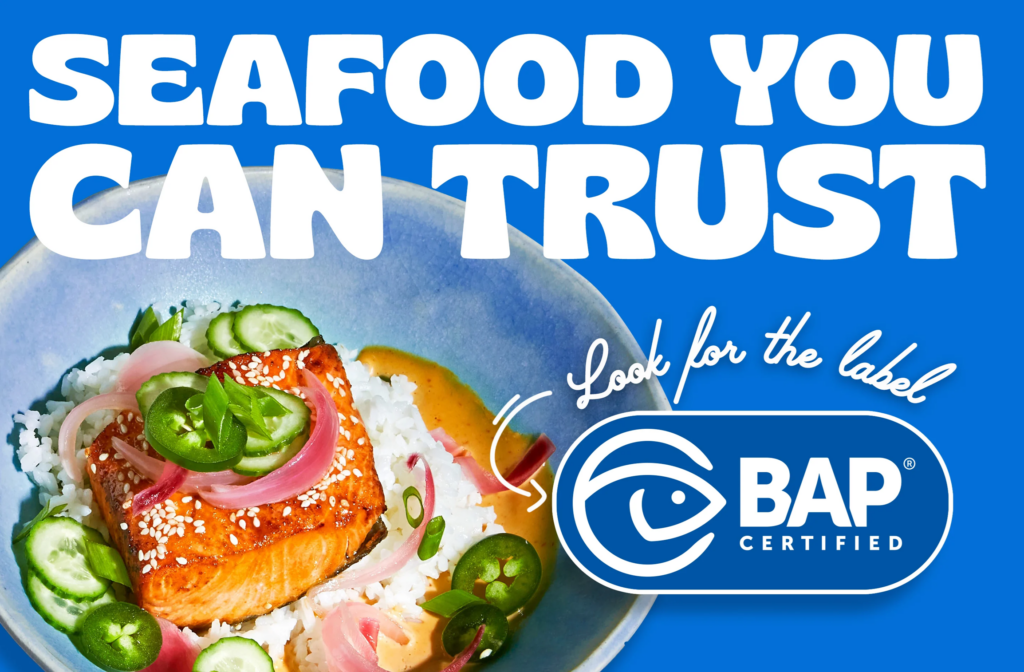
BAP presents itself as an independent certification program that verifies responsible aquaculture—a kind of seal of approval meant to assure shoppers that the farmed fish and shrimp they’re buying was raised under rigorous environmental and social standards. BAP’s own marketing director described the campaign’s goal as giving shoppers “a clear, trusted shortcut to make better seafood choices.”
A “shortcut.” That word choice is worth sitting with.
What BAP is selling here isn’t transparency so much as a replacement for it—a logo engineered to resolve the question before it’s asked, to move product by removing doubt. As this toolkit rolls out across Save Mart and Lucky stores, the public record on BAP tells a very different story than the one appearing at the seafood counter.
Who Runs BAP—and Who Pays for It
BAP is administered by the Global Seafood Alliance, an industry group with roots in corporations like Cargill and Monsanto. Forty-two percent of its Board of Directors represent companies that produce, process, distribute, or sell sea animals or aquafeed. Another 27 percent are major buyers or distributors of seafood. The people setting the standards are, in significant part, the people who have to meet them.
Further, the program is sustained through membership dues and licensing fees paid by the companies seeking certification. That means that BAP’s financial survival depends on keeping producers certified and in good standing, creating a hard ceiling on how demanding those standards can ever realistically get. Push requirements too far, and lose members and revenue.
What the Standards Actually Allow
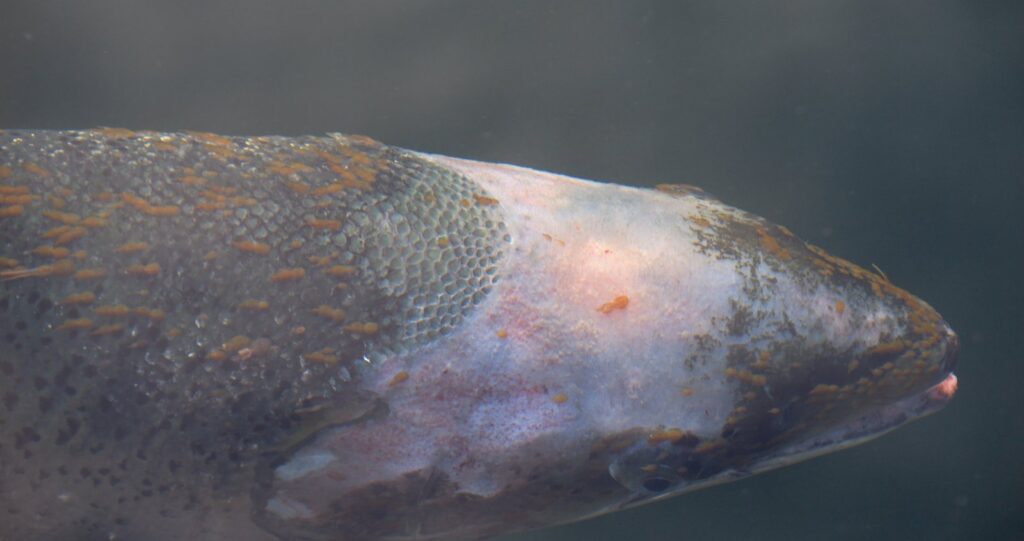
The standards BAP has developed under this structure reflect exactly the conflicts of interest that produced them. Take sea lice—the parasites that devastate juvenile wild fish populations near open-net salmon farms, and one of the most serious and well-documented ecological concerns associated with industrial salmon farming. BAP sets no quantitative limits on sea lice whatsoever. Environmental organizations have independently documented BAP-certified farms with sea lice levels as high as 51 per fish. To put that in perspective, sea lice are not a minor irritation like human head lice: they attach to a fish’s skin, feeding on mucus, blood, and flesh, leaving open wounds that can lead to infection, stress, and death. A salmon carrying dozens of lice is effectively being eaten alive. Under BAP’s framework, though, this number triggers nothing—no warnings, citations, or suspensions.
On antibiotic use, BAP’s salmon standard requires only vague veterinary oversight, with no clear limits on the amounts of drugs used or the frequency of treatment. This matters well beyond the farm level: antibiotic overuse in aquaculture is a documented contributor to the antimicrobial resistance (AMR) crisis, one of the world’s greatest public health threats according to the World Health Organization. By 2030, animal aquaculture is on track to use more antibiotics per kilogram produced than any other farm animal sector—and BAP is doing nothing to prevent this.
Peeling Back the Label
The most damaging evidence against BAP comes from inside its certified supply chains. In 2024, The Outlaw Ocean Project published a major investigation into Choice Canning, one of India’s largest shrimp exporters and, at the time, a BAP-certified operation. A whistleblower hired as general manager of a Choice Canning processing plant discovered that despite the company’s certification, shrimp processed there was not coming from BAP-certified farms. When he raised this with the company’s senior quality assurance manager, the response was blunt: “We never buy shrimp from BAP farms. All are local, unregistered farms.” Considerable “documentation skills,” the manager added—with a smiley-face emoji—were required to make it appear otherwise.
The investigation found that workers’ living quarters were in severe disrepair, with employees sleeping on the floor using their shirts as pillows and more than 500 mattresses infested with bedbugs. One hundred and fifty workers had not had a single day off in a year. When one worker attempted to escape by climbing the facility’s rear wall, management ordered the wall repaired to prevent others from following. Meanwhile, ahead of audits, staff falsified paperwork and relocated workers off-site to conceal the facility’s true numbers—a practice two managers later confirmed in writing. Reporters subsequently found BAP-labeled shrimp from the implicated facility still on shelves at a Pennsylvania grocery store, carrying the BAP certification number, even after the facility had disappeared from BAP’s list of certified producers.
The Choice Canning case is not an anomaly. A three-year investigation by Corporate Accountability Lab found that working conditions at BAP-certified facilities in India were broadly indistinguishable from those at uncertified facilities, with documented violations including forced labor, restriction of movement, wage theft, gender-based violence, child labor, and harmful groundwater contamination in surrounding communities.
The Accountability Gap
Certification programs derive their credibility from accountability. The implicit promise to consumers is not just that standards exist, but that farms are held to them—that violations have consequences and that the label means something was inspected and found acceptable.
BAP cannot make that promise in any verifiable way. According to a SeaChoice review of BAP’s accountability structures, audit reports and summaries are not published—BAP states this is for reasons of confidentiality. A consumer, journalist, or independent researcher who wanted to know whether a BAP-certified facility had been flagged for violations, what was required of it, or whether it remained certified would have no way of finding out.
One might expect government oversight to fill this gap. However, the FDA tests only 0.1 percent of shrimp imports for banned antibiotics—substances prohibited because of their links to cancer and other illnesses and the accelerating AMR crisis. Even at that minimal rate of scrutiny, the agency still refuses dozens of contaminated shipments each year, suggesting many more pass through undetected. According to the Southern Shrimp Alliance, 87 percent of Indian shrimp entry lines rejected at the U.S. border in 2024 for antibiotic contamination originated from BAP-certified facilities. This has continued into the present, with 78.6 percent of shrimp refusals attributed to BAP-certified facilities so far in 2026.
BAP-certified facilities failing even the FDA’s cursory screening at such high rates is a window into a much larger problem that, by design, remains impossible to fully see. A certification program that cannot be independently scrutinized—and whose integrity cannot be verified—is, functionally, a marketing tool. As it turns out, this is exactly how BAP is now deploying it.
The Broader Problem with “Sustainable Seafood”
BAP’s “Seafood You Can Trust” campaign is the latest example of something the aquaculture industry has been doing for years: using certification infrastructure to convert consumer concern into consumer confidence, without doing the underlying work that confidence would require.
AAP and Farm Forward’s research found this pattern consistent across the major aquaculture certification schemes. The Aquaculture Stewardship Council (ASC), for example, which positions itself as the more rigorous alternative, is similarly dependent on licensing fees from producers and retailers, creating the same structural ceiling on standards. In 2022, an investigation by WildFish found that five out of six ASC-certified Scottish salmon farms supplying a major UK retailer averaged sea lice counts eight times higher than ASC’s own limit, with some exceeding the threshold thirty times over. All kept their certification. A 2018 review of 456 ASC audit reports found widespread inconsistencies and lenient enforcement, with farms certified despite failing to meet core requirements.
These are not isolated failures, but the predictable output of certification systems built to serve producers, funded by producers, and structurally unable to hold producers genuinely accountable. The result is a system that projects the appearance of accountability while enabling business as usual—misleading conscientious consumers, institutions, and foodservice leaders into believing they are making responsible choices when the system behind that belief was never designed to deliver on it.
In short, “Seafood You Can Trust” is nothing more than a marketing campaign. The certification behind it has no public audit trail, no sea lice limits, no meaningful antibiotic standards, a board dominated by the companies it oversees, and a documented history of falsified documentation at certified facilities. Shoppers at Save Mart and Lucky stores will soon see this label at the seafood counter and be told it represents responsible sourcing. They deserve to know what it actually represents.
Read AAP’s full analysis of aquaculture certifications and ratings in The Myth of “Sustainable” Aquaculture and learn how to avoid certification greenwashing in our Solutions Guide.