
The aquaculture industry has spent decades perfecting its story. Our flagship report, The Myth of “Sustainable” Aquaculture, dismantles five of the industry’s most pervasive claims, from the idea that fish farming reduces pressure on wild fisheries, to the certifications the industry uses to launder its image.
Read the report. Share it with your networks. The more people understand what industrial aquaculture actually is, the harder it becomes for the industry to hide.

The simplest way to withdraw your support from this industry is to eat less of what it produces. Reducing how much fish and shrimp you eat overall is one of the most direct things you can do for ocean health—and if you do eat sea animals, knowing what to avoid matters. Farmed salmon and farmed shrimp are among the most environmentally costly products, and among the most misleadingly marketed.
Our solutions page outlines practical solutions that are better for the ocean, for wild fish populations, and for you.
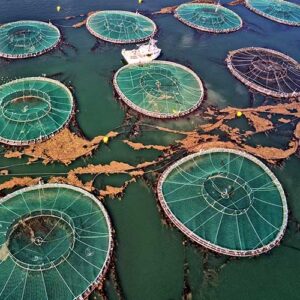
Now the industry wants to expand into U.S. federal ocean waters, where no large-scale industrial fish farming has ever been permitted. The Marine Aquaculture Research for America Act (MARA Act, S. 2586) frames this as a modest “research” program. In reality, it would allow corporations to secure 10-year leases to plant massive fish farming operations across U.S. offshore waters—spending millions in taxpayer dollars along the way on a PR campaign to clean up aquaculture’s dirty reputation.
More than 420 conservation organizations, chefs, businesses, and fisherman’s groups aren’t buying it. Critics warn it’s a one-way door to permanent offshore factory farms—and that once the cages go in, they don’t come out.
Don’t Cage Our Oceans is collecting signatures to send directly to the Senate. It takes less than a minute.
Industrial aquaculture companies have the resources to shape policy, flood markets, and control the narrative. What they can’t control is an informed public that sees through the greenwashing and refuses to buy the story, or the product. This World Oceans Month, choose to be part of the shift. Sign up for updates and the latest ways to stay involved.